Send the water somewhere else.
Standing water, a soggy low spot, a damp basement wall. It all traces back to where the water goes. We find the path it takes and change it.
Clay does not drain. Water has to be given a path.
Most of Washtenaw and Jackson County sits on dense, clay-heavy soil. Rain does not soak away the way it does in sand. It sits on the surface, or it travels sideways just under the sod until something stops it.
So the same handful of problems show up on nearly every call. A low spot that never dries out. Downspouts dumping the entire roof against the foundation. A yard that was graded toward the house instead of away from it. Water finding the basement wall because that is the lowest, easiest route available to it. The fix is rarely a single product. It is deciding where the water should end up, then building a path it will actually take.
- Find the source first, because roof water, surface runoff, a hillside seep and a neighbor’s grade each need a different fix.
- Downspouts carried away from the foundation in solid pipe, out to daylight or a pop-up outlet well clear of the house.
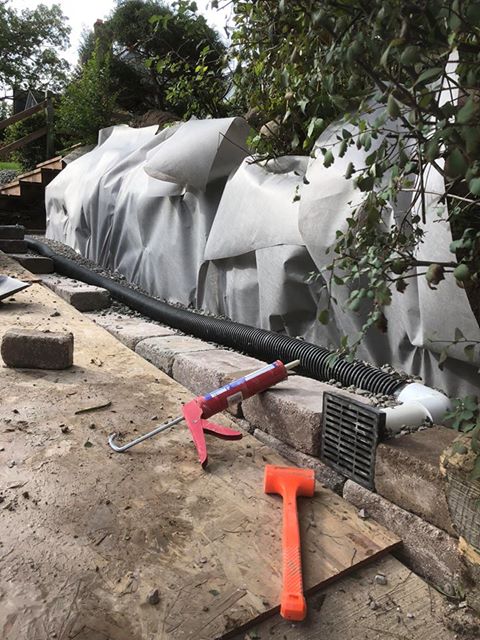
- Perforated pipe in washed stone wrapped in filter fabric, so the trench keeps moving water instead of silting shut.
- Positive grade away from the house, since no pipe can outrun a yard that pitches the wrong direction.
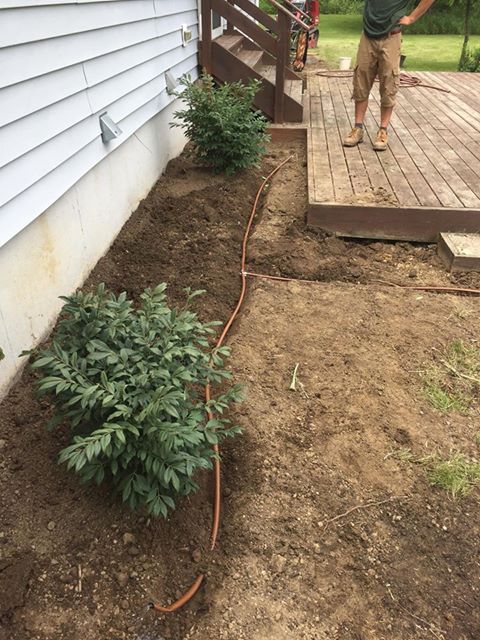
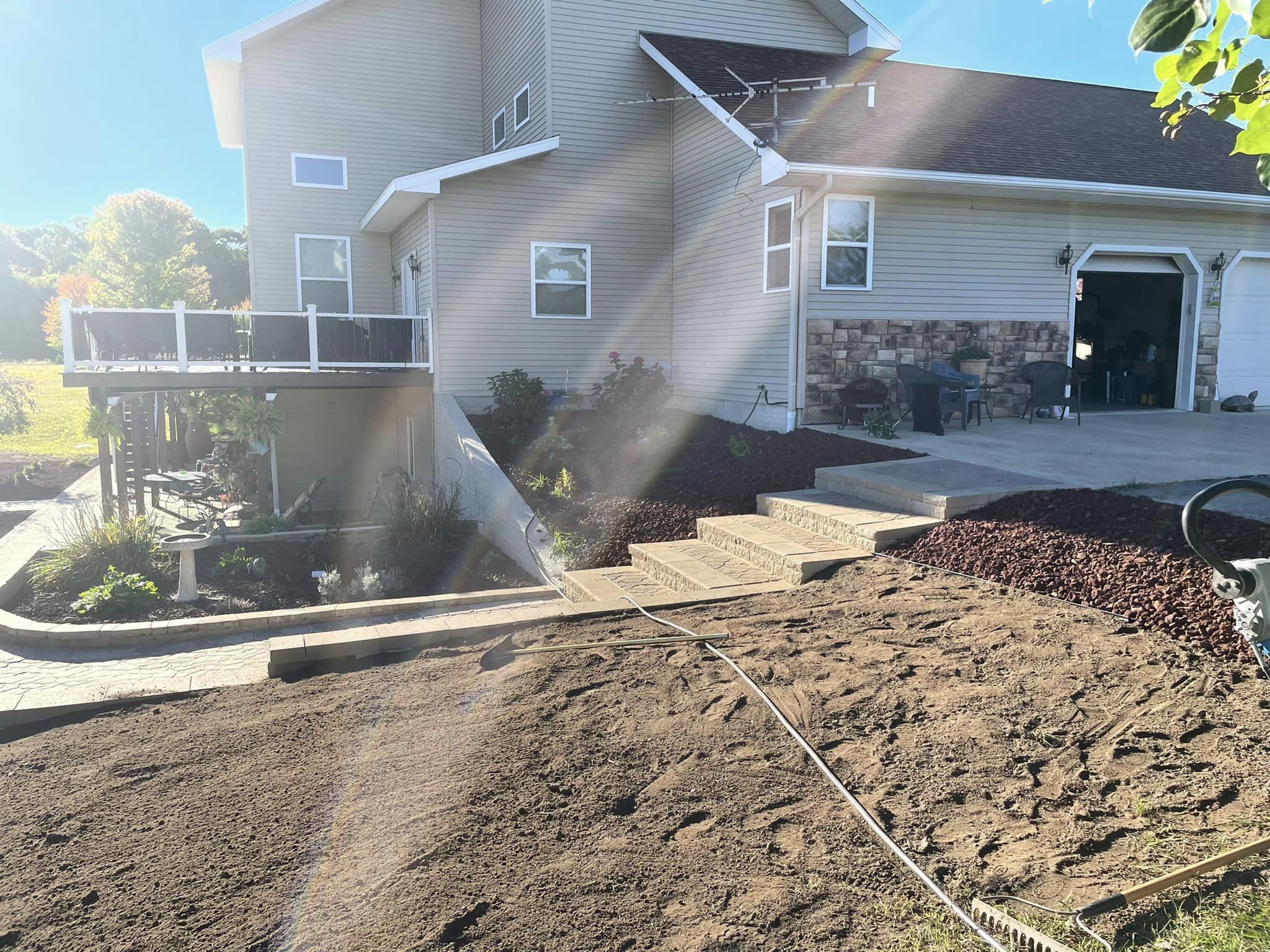
Four ways to move water, matched to the actual problem
Most wet yards need two of these working together. We price them as one plan so you are not paying twice to dig the same ground.
A sloped trench of washed stone with perforated pipe, wrapped in filter fabric, that collects water out of saturated soil and carries it away. The fabric and the pitch are what separate a drain that works from a gravel ditch.
The cheapest real fix on most properties. Roof water is the single biggest volume hitting your foundation, and buried solid pipe takes it out past the beds instead of releasing it four feet from the wall.
Reshaping the ground so water leaves on its own. Re-grading around the house, cutting a shallow swale to route runoff, and stabilizing slopes that are washing out after every heavy rain.
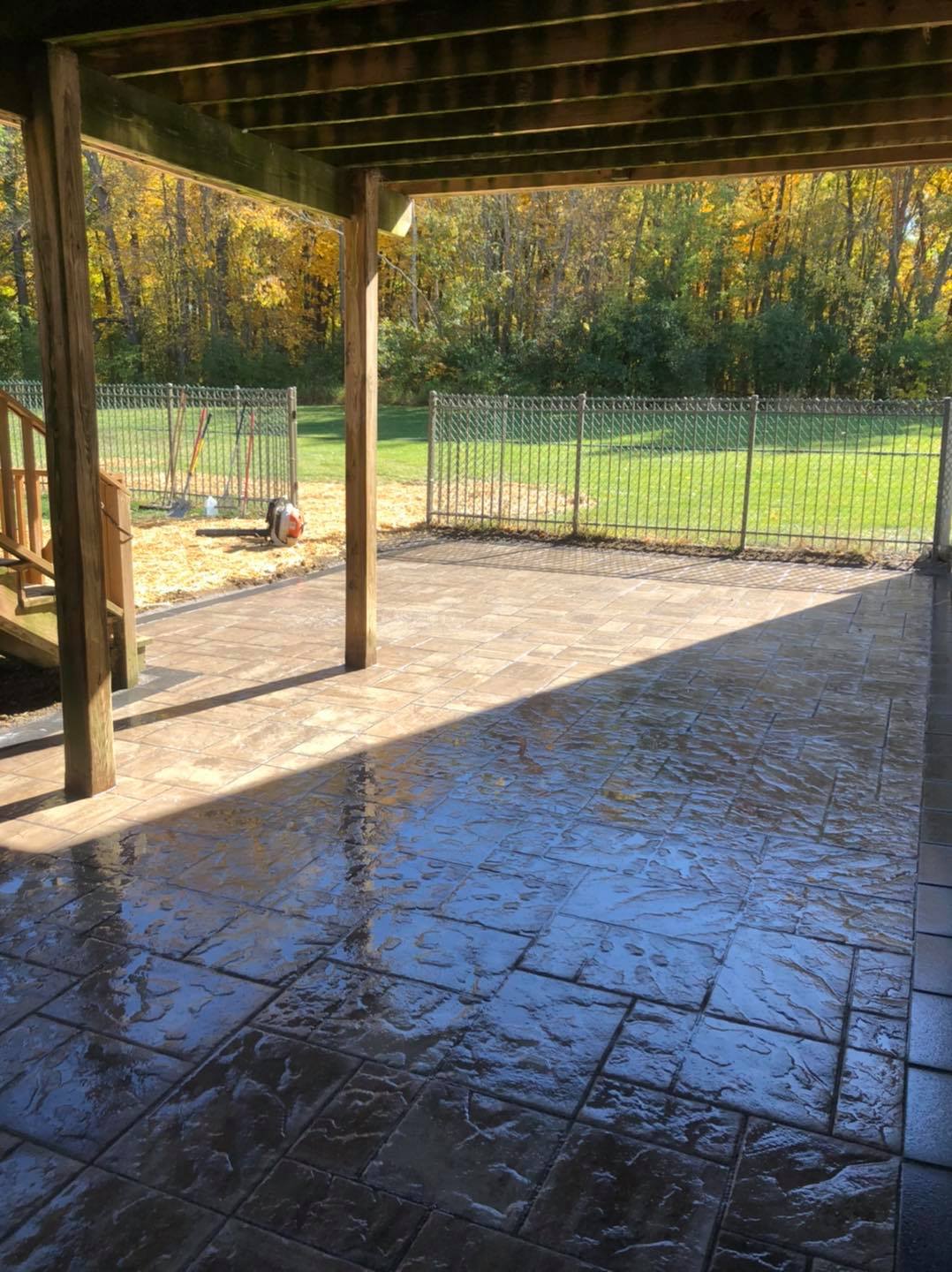
Grated basins and surface inlets that pick up standing water at patios, driveways, walkouts and under decks, then tie into the same buried line so the hard surfaces stop feeding the low spot.
What a drainage job actually looks like
Almost all of this work ends up invisible, which is exactly why it is worth seeing before it gets buried.

Four steps, no surprises
Walk it wet if we can
We look at the low spots, the downspouts, the grade at the foundation and where your property sits relative to the neighbors. Seeing it during or right after a rain tells us the most.
Plan the path and quote it
Where the water is collected, the route it takes, and where it discharges, with the pipe run and any basins listed on a written quote.
Dig, pitch, wrap, backfill
Trench to a consistent fall, set filter fabric and washed stone, lay pipe, tie in the downspouts and basins, then backfill and compact.
Restore and show you
Seed or sod goes back over the trench, beds are reset, and we walk the route with you so you know where every line runs before it disappears.
What yard drainage costs in Michigan
Installed drainage in Southeast Michigan generally runs $25 to $60 per linear foot, and most residential projects land between $1,500 and $6,000 and up depending on how much ground has to be opened.
Downspout & surface lines
Standard French drain
Deep or foundation-side
What drives the number: how far the water has to travel to a legal outlet, trench depth, how many downspouts and basins tie in, whether the machine can reach the work or the trench is dug by hand, whether we are cutting through an existing patio, driveway or irrigation, and how much sod, seed or bed restoration you want afterward. We publish these ranges so you can tell the difference between a real drainage plan and a load of gravel dumped in a ditch.
French drain vs. surface drains vs. re-grading
| Approach | Typical cost | What it actually solves | Best for |
|---|---|---|---|
| French drain / drain tile | $35–60 per linear ft | Pulls water out of soil that is already saturated below the surface | Soggy ground that never dries, hillside seeps, water against a foundation wall |
| Surface drains & catch basins | $25–35 per linear ft | Captures water standing on top of the ground and pipes it away | Downspouts, patio and driveway runoff, one stubborn puddle in the lawn |
| Grading & swales | $1,500–5,000 typical | Changes where water travels before it ever has a chance to collect | Yards pitched toward the house, runoff sheeting in from a neighboring lot |
On most properties the right answer is a combination. Re-grading and buried downspout lines handle the volume, and a French drain picks up what is left in the soil. A contractor who quotes pipe without ever mentioning your grade or your gutters has not looked at the whole problem.
Where we build
We are based on Maute Road in Grass Lake, so we work on the exact clay these communities sit on.
Talk to a real local builder
Tell us where the water shows up. We will walk the property, explain what is actually causing it, and put a straight number in writing.
- (734) 478-1644
- info@bloomslandscapingllc.com
- 3998 Maute Rd, Grass Lake, MI 49240
Drainage questions, answered
How much does a French drain cost in Michigan?
Most installed drainage in Southeast Michigan runs $25 to $60 per linear foot, and typical residential projects land between $1,500 and $6,000 and up. Shallow downspout and surface lines are at the low end, a standard French drain with washed stone and sock pipe sits in the middle, and deep or foundation-side work with poor access is at the top. Distance to a workable outlet is usually the biggest single factor. We give a firm written number after seeing the site.
Why does water stand in my yard after it rains?
Because clay soil does not absorb it. Once the top few inches are saturated, everything else has to run somewhere across the surface, and it stops at the lowest point it can reach. Add a roof feeding several thousand gallons through four downspouts and a yard that was graded flat, and standing water is the expected outcome, not a fluke.
Will a French drain fix a wet basement?
Often it helps a great deal, but only if the water is coming from outside. Exterior drainage, buried downspout lines and correcting the grade at the foundation remove most of the water pressing against the wall. If the source is a failed interior sump system, a cracked wall or groundwater under the slab, that is a basement waterproofing job and we will tell you so rather than sell you a trench that will not fix it.
What is the difference between a French drain and a curtain drain?
They are built the same way. A French drain is generally set in the wet area to collect water that is already there. A curtain drain is placed uphill of the area you want to protect, so it intercepts water before it arrives. On a sloped Michigan lot the interception approach is frequently the smarter one.
Where should my downspouts discharge?
Well away from the foundation, at a point where the water can keep moving. Splash blocks and short extensions just move the problem a few feet. We run solid buried pipe out to daylight at a lower point of the property or to a pop-up emitter clear of the house, beds and walkways.
Do I need a permit for yard drainage?
Residential drainage usually does not require a permit in our local municipalities, but discharging into a road ditch, a county drain or across a property line can carry rules, and septic fields and easements have to be respected. We check with the township during the estimate and route the outlet accordingly.
Can you fix a yard that slopes toward the house?
Yes. That is a grading correction, sometimes combined with a retaining or seating wall where the drop is significant. Reshaping the ground so it falls away from the foundation is the most durable fix available, and it is usually paired with buried downspout lines. See our retaining wall installation page when the grade change needs a structure to hold it.
Will the work tear up my lawn?
There will be an open trench while we are working, and there is no way around that. We keep the cut as narrow as the job allows, protect the surrounding turf, backfill and compact, then seed or sod the line. Bed edges, mulch and plants get put back before we leave.
Stop fighting water in your yard
Book a free on-site estimate. We will walk the property, find where the water is coming from, and give you a straight answer on what it takes and what it costs.